
Bioinformatics MS
Students Major: Bioinformatics
Degree Awarded: Master of Science (MS)
Calendar Type: Quarter
Minimum Required Credits: 45.0
Co-op Option: None
Classification of Instructional Programs (CIP) code: 26.1103
Standard Occupational Classification (SOC) code: 15-1221; 15-1299; 15-2051; 19-4021; 15-1252
About the Program
The Bioinformatics program aims to train professional graduates for bioinformatics specialist roles in healthcare, biomedical research, pharmaceutical, and biotechnology industries by providing them with interdisciplinary knowledge and experience to develop and apply sophisticated computational methods for the analysis of biomedical data. The program consists of classes and electives included in certificates offered by the School of Biomedical Engineering and Science (Bioinformatics, Neurotechnologies and Neurosystems), the School of Computer and Information Sciences (Computational Data Science), the School of Engineering (Machine Learning Engineering) and the Graduate School of Biomedical Science and Professional Studies (Drug Discovery and Development).
Master's students can choose to include a six-month graduate co-op cycle as part of their studies, supported by Drexel's Steinbright Career Development Center.
Pathways to Completion
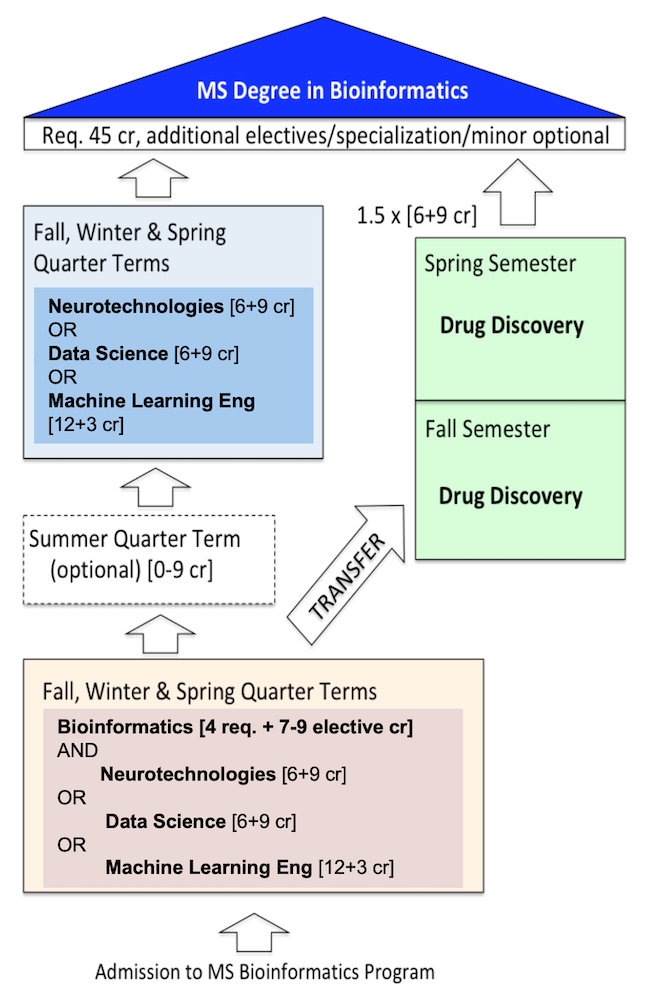
As the graphic below indicates, students have defined pathways to earning the MS in Bioinformatics. The program starts with required and elective core classes in bioinformatics, and a choice of a specialization in either Computational Data Science or Neurotechnology and Neurosystems or Machine Learning Engineering over the first three quarter terms. In the second year, students have the choice to remain in the quarter term system to take a second specialization or transfer into the semester-based system to take classes in the Drug Discovery and Development Certificate offered by the College of Medicine. Additional options include graduate minors across Drexel's academic units.
Additional Information
For questions about how to apply to the program, please contact:
Natalia Broz
Associate Director for Graduate Programs
School of Biomedical Engineering and Science
Email: njb33@drexel.edu
Andres Kriete, PhD
Associate Dean for Academic Affairs
School of Biomedical Engineering and Science
Email: ak3652@drexel.edu
For more information, visit the The School of Biomedical Engineering and Science website.
Admission Requirements
Acceptance into the MS in Bioinformatics program requires a four-year bachelor's degree in sciences or engineering from a regionally accredited institution in the United States or an equivalent international institution. Regular acceptance typically requires a minimum cumulative grade point average of 3.0. The average for any graduate work must be at least 3.0.
Applicants must also fulfill the following requirements for consideration:
- Official transcripts from all colleges and universities attended
- References from at least two instructors or professionals
- Essay
- Resume
International applicants (non-United States citizens) must meet the same requirements for admission as students from the United States. Applicants whose native language is not English must demonstrate the ability to speak, write, and understand the English language by submitting an acceptable score on the Test of English as a Foreign Language (TOEFL). An evaluation by World Education Services (WES) is required for transcripts from institutions outside the United States.
Online applications are accepted all year-round, but all admitted students initiate their studies in the following fall term. Students are encouraged to apply no later than July 1 for consideration for admission the following fall term. Students may defer admission by one year.
Degree Requirements
| Core Required Courses | ||
| BMES 546 | Biocomputational Languages | 4.0 |
| or BMES 550 | Advanced Biocomputational Languages | |
| BMES 544 | Genome Information Engineering | 4.0 |
| Core Elective Courses | ||
| Select 7.0-9.0 credits from the list below: | 7.0-9.0 | |
| Quantitative Systems Biology | ||
| Structural Bioinformatics and Drug Design | ||
| Machine Learning in Biomedical Applications | ||
| Biosystems Modeling | ||
| Genomic and Sequencing Technologies | ||
| Biomedical Signal Processing | ||
| Pharmacogenomics | ||
| Elective Tracks | ||
| Select two from the following: (Please note DDD Elective Track requires advisor approval for quarter-based students) | 30.0 | |
| [Elective Track 1] Computational Data Sciences (CDS) | ||
| Required Courses (6 credits) | ||
| Data Acquisition and Pre-Processing | ||
| Data Analysis and Interpretation | ||
| Elective Courses (Choose 9 credits) | ||
| Fundamentals of Databases | ||
| Introduction to Artificial Intelligence | ||
| Introduction to Computer Vision | ||
| Machine Learning | ||
| Deep Learning | ||
| Data Analysis at Scale | ||
| [Elective Track 2] Drug Discovery and Development (DDD) | ||
| Required courses (6 semester credits) | ||
| Drug Discovery and Development I | ||
| Drug Discovery and Development II | ||
| Elective courses (Choose 9 semester credits) | ||
| Cancer Biology | ||
| Epidemiology | ||
| Ethical Issues in Research | ||
| Business Processes and Contemporary Concerns in Pharmaceutical R & D | ||
| World Wide Regulatory Submissions | ||
| Intro to Clinical Trials | ||
| Applications of Clinical Research Biostatistics | ||
| Scientific Writing and Medical Literature | ||
| Current Federal Regulatory Issues in Biomedical Research | ||
| Pharmaceutical Law | ||
| Leadership Skills | ||
| Compliance & Monitoring Issues | ||
| Principles and Practice of Pharmacovigilance | ||
| Designing the Clinical Trial | ||
| Innovative Product Development | ||
| Fundamentals of Compliance | ||
| Introduction to Clinical Pharmacology | ||
| Informatics in Pharm Res & Development | ||
| Regulatory, Scientific and Social Issues Affecting Biotech Research | ||
| Health Policy and Economics | ||
| Strategic Planning | ||
| Special Topics in Clinical Research | ||
| Responsible Conduct of Research | ||
| Immunology I | ||
| Biotechniques I: Molecular and Genomic Methods | ||
| Vaccines and Vaccine Development | ||
| Fundamentals of Molecular Medicine I | ||
| Fundamentals of Molecular Medicine II | ||
| Animal Models for Biomedical Research | ||
| Statistics for Neuro/Pharm Research | ||
| Graduate Neuroscience I | ||
| Graduate Physiology | ||
| Current Topics in Pharmacology & Physiology | ||
| Pharm & Phys 1st Lab Rotation | ||
| Prin of Neuropharmacology | ||
| Graduate Pharmacology | ||
| Advanced Topics in Physiology | ||
| Advanced Topics in Pharmacology | ||
| New Frontiers in Therapy | ||
| Methods in Biomedical Research | ||
| Internship in Drug Discovery and Development | ||
| Intensive Internship in Drug Discovery and Development | ||
| Current Topics in Drug Discovery and Development | ||
| Research in Drug Discovery and Development | ||
| [Elective Track 3] Neurotechnologies and Neurosystems (NN) | ||
| Required courses for Option 3 | ||
| Neural Signals | ||
| Principles in Neuroengineering | ||
| Elective courses for Option 3 (Choose 9 credits) | ||
| Experimental Methods in Neuroengineering | ||
| Systems Neuroscience and Applications I | ||
| Brain Computer Interfaces | ||
| Neural Networks | ||
| [Elective Track 4] Machine Learning Engineering (MLE) | ||
| Required courses for Option 4 | ||
| Machine Learning & Artificial Intelligence | ||
| Applied Machine Learning Engineering | ||
| Pattern Recognition | ||
| Probability & Random Variables | ||
| Elective courses for Option 4 (choose at least one): | ||
| Cell & Tissue Image Analysis | ||
| Multimedia Forensics and Security | ||
| Bioinformatics | ||
| Statistical Analysis of Genomics | ||
| Optional Coop Experience * | 0-1 | |
| Career Management and Professional Development for Master's Degree Students | ||
| OPTIONAL CONCENTRATION - Not eligible for Federal Financial Aid | 0.0-20.0 | |
| Total Credits | 45.0-68.0 | |
- *
Co-op is an option for this degree for full-time on-campus students. To prepare for the 6-month co-op experience, students will complete: COOP 500. The total credits required for this degree with the co-op experience is 46.0
Students not participating in the co-op experience will need 45.0 credits to graduate.
Biomedical Technology Development Concentration (Optional) - Not eligible for Federal Financial Aid
Students enrolled in this concentration will develop an understanding of critical regulatory, economic, and legal issues in addition to the project management skills that facilitate the development of new medical devices and positive working relationships with intellectual property lawyers, insurance companies, and the federal government.
| BMES 509 | Entrepreneurship for Biomedical Engineering and Science | 3.0 |
| BMES 534 | Design Thinking for Biomedical Engineers | 3.0 |
| BMES 538 | Biomedical Ethics and Law | 3.0 |
| BMES 588 | Medical Device Development | 3.0 |
| BMES 596 | Clinical Practicum | 3.0 |
| Total Credits | 15.0 | |
Biomaterials and Tissue Engineering Concentration (Optional) - Not eligible for Federal Financial Aid
This concentration is designed to provide students with advanced training in cellular and molecular biology relevant to tissue engineering and behavior of materials used in biomedical applications.
| BMES 631 | Tissue Engineering I | 4.0 |
| BMES 632 | Tissue Engineering II | 4.0 |
| BMES 660 | Biomaterials I | 0.0,4.0 |
| BMES 661 | Biomaterials II | 0.0,4.0 |
| BMES 675 | Biomaterials and Tissue Engineering III | 0.0,4.0 |
| Total Credits | 8.0-20.0 | |
Pediatric Engineering Concentration (Optional) - Not eligible for Federal Financial Aid
This concentration aims to train students: 1) to develop a fundamental understanding of childhood injury and disease, healthcare, and treatment, and 2) to apply scientific and engineering concepts, methods, and approaches to address healthcare challenges with direct relevance to pediatric patients.
| BMES 528 | Pediatric Engineering I | 3.0 |
| BMES 529 | Pediatric Engineering II | 3.0 |
| BMES 538 | Biomedical Ethics and Law | 3.0 |
| BMES 509 | Entrepreneurship for Biomedical Engineering and Science | 3.0 |
| Total Credits | 12.0 | |
Neuroengineering Concentration (Optional) - Not eligible for Federal Financial Aid
This concentration aims to train students 1) to develop a fundamental understanding of neural systems from cellular, to whole brain level, and 2) operational principles of neurotechnologies that can interface with nervous systems, 3) to apply scientific and engineering concepts to repair nervous system for clinical applications or enhance its functional performance.
| BMES 710 | Neural Signals | 3.0 |
| BMES 711 | Principles in Neuroengineering | 3.0 |
| BMES 715 | Systems Neuroscience and Applications I | 3.0 |
| BMES 718 | Brain Computer Interfaces | 3.0 |
| BMES 725 | Neural Networks | 3.0 |
| Total Credits | 15.0 | |
Sample Plan of Study
Elective track 1 (All quarter courses):
| First Year | ||
|---|---|---|
| Fall | Credits | |
| BMES 546 or BMES 550 | Biocomputational Languages or Advanced Biocomputational Languages | 4.0 |
| BMES 710 | Neural Signals | 3.0 |
| COOP 500 | Career Management and Professional Development for Master's Degree Students | 1.0 |
| CS Elective | 3.0 | |
| Credits | 11 | |
| Winter | ||
| BMES 544 | Genome Information Engineering | 4.0 |
| BMES 547 | Machine Learning in Biomedical Applications | 3.0 |
| BMES 711 | Principles in Neuroengineering | 3.0 |
| Credits | 10 | |
| Spring | ||
| BMES 543 | Quantitative Systems Biology | 4.0 |
| BMES 678 | Biocomputational Modeling and Simulation | 3.0 |
| BMES 725 | Neural Networks | 3.0 |
| Credits | 10 | |
| Summer | ||
| BMES 604 | Pharmacogenomics | 3.0 |
| CS Elective | 3.0 | |
| Credits | 6 | |
| Second Year | ||
| Fall | ||
| COOP EXPERIENCE | ||
| Credits | 0 | |
| Winter | ||
| COOP EXPERIENCE | ||
| Credits | 0 | |
| Spring | ||
| BMES 611 | Biological Control Systems | 3.0 |
| BMES 715 | Systems Neuroscience and Applications I | 3.0 |
| CS Elective | 3.0 | |
| Credits | 9 | |
| Total Credits | 46 | |
Elective Track 2 (with semester courses)
First year, Quarter courses
| First Year | ||
|---|---|---|
| Fall | Credits | |
| BMES 546 or BMES 550 | Biocomputational Languages or Advanced Biocomputational Languages | 4.0 |
| BMES 718 | Brain Computer Interfaces | 3.0 |
| Credits | 7 | |
| Winter | ||
| BMES 544 | Genome Information Engineering | 4.0 |
| BMES 547 | Machine Learning in Biomedical Applications | 3.0 |
| BMES 548 | Structural Bioinformatics and Drug Design | 3.0 |
| Credits | 10 | |
| Spring | ||
| BMES 549 | Genomic and Sequencing Technologies | 3.0 |
| BMES 685 | Experimental Methods in Neuroengineering | 2.0 |
| BMES 604 | Pharmacogenomics | 3.0 |
| Credits | 8 | |
| Summer | ||
| Complete Quarter; Enroll as Semester | ||
| Credits | 0 | |
| Total Credits | 25 | |
With Coop and Neuro
| First Year | ||
|---|---|---|
| Fall | Credits | |
| BMES 546 or BMES 550 | Biocomputational Languages or Advanced Biocomputational Languages | 4.0 |
| BMES 710 | Neural Signals | 3.0 |
| COOP 500 | Career Management and Professional Development for Master's Degree Students | 1.0 |
| CS Elective | 3.0 | |
| Credits | 11 | |
| Winter | ||
| BMES 544 | Genome Information Engineering | 4.0 |
| BMES 547 | Machine Learning in Biomedical Applications | 3.0 |
| BMES 711 | Principles in Neuroengineering | 3.0 |
| Credits | 10 | |
| Spring | ||
| BMES 543 | Quantitative Systems Biology | 4.0 |
| BMES 678 | Biocomputational Modeling and Simulation | 3.0 |
| BMES 725 | Neural Networks | 3.0 |
| Credits | 10 | |
| Summer | ||
| BMES 604 | Pharmacogenomics | 3.0 |
| CS Elective | 3.0 | |
| Credits | 6 | |
| Second Year | ||
| Fall | ||
| COOP EXPERIENCE | ||
| Credits | 0 | |
| Winter | ||
| COOP EXPERIENCE | ||
| Credits | 0 | |
| Spring | ||
| BMES 611 | Biological Control Systems | 3.0 |
| BMES 715 | Systems Neuroscience and Applications I | 3.0 |
| CS Elective | 3.0 | |
| Credits | 9 | |
| Total Credits | 46 | |